
The PCB potting industry aims to achieve full encapsulation of circuit boards using high-performance materials to improve environmental resistance and structural reliability. Potting compounds must simultaneously withstand moisture, chemical corrosion, and thermal stress to ensure long-term stable operation of electronic components under harsh conditions.
Among various material systems, Hydroxyl-Terminated Polybutadiene (HTPB) is widely adopted in electronic-grade PCB potting formulations due to its exceptional flexibility, low water absorption, and excellent crosslinking capability. Its unique polymer structure enables the encapsulation layer to provide superior stress relief and anti-aging performance, fundamentally improving product reliability and service life.
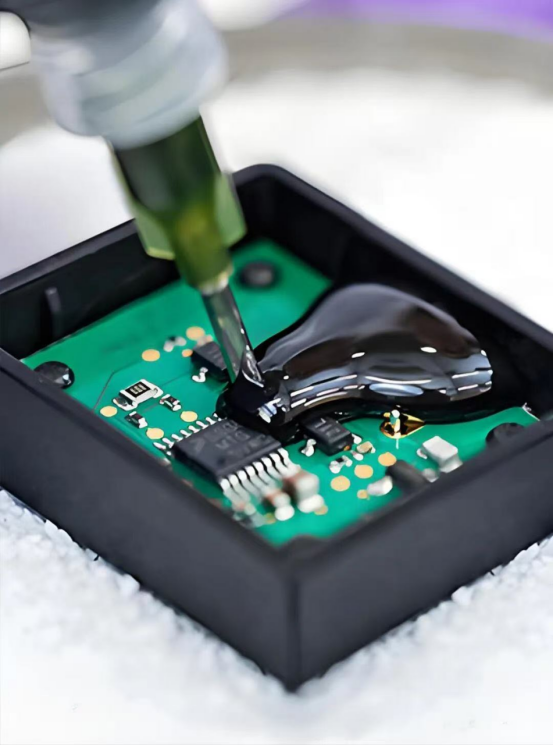
Its key chemical and physical properties include:
Flexibility: The polymer structure of HTPB offers outstanding elasticity, allowing it to withstand high-stress environments without cracking.
Thermal stability: HTPB maintains excellent mechanical performance across a broad temperature range, making it suitable for both low- and high-temperature environments.
······
For full technical specifications, please refer to CAS: 69102-90-5 HTPB.
HTPB features excellent elasticity, low-temperature flexibility, and strong crosslinking capability. It significantly enhances the crack resistance and aging resistance of potting compounds, propellants, and polyurethane systems—effectively addressing brittleness issues under extreme conditions. Its controlled molecular weight and high-purity hydroxyl groups ensure stable and repeatable reactions with isocyanates, minimizing batch variations and improving consistency and stability of the final product.
HTPB also has broader applications, including:
Forms a highly elastic, low-volatility polyurethane matrix with excellent oxidation and thermal resistance, capable of withstanding mechanical stress under high thrust conditions.
Low glass transition temperature (Tg ≈ −70°C) and high elongation, providing finished products with outstanding wear resistance and low-temperature crack resistance.
Terminal hydroxyl groups react precisely with various isocyanates, enabling control of crosslink density to balance strength and toughness.
HTPB-based systems offer low water absorption, low-temperature flexibility, and stable dielectric properties.
By adjusting molecular weight and crosslink density, HTPB effectively relieves stress, reducing cracking caused by thermal cycling.
It can be formulated with halogen-free isocyanates and thermal conductive fillers (aluminum oxide, boron nitride) to enhance heat dissipation while maintaining dielectric performance.
When blended with other polymers, HTPB improves low-temperature toughness and impact resistance and is easy to modify through formulation adjustment.
By controlling hydroxyl value, dispersity, and antioxidant additives (e.g., tailored antioxidant systems), HTPB achieves extended storage stability while reducing risks of yellowing and degradation.
Our HTPB has been successfully applied in a customer’s PCB potting system. Long-term thermal cycling and aging tests demonstrate excellent flexibility and interfacial adhesion, greatly improving the durability of the encapsulated components.
Our HTPB is produced in strict accordance with international chemical quality and safety standards and complies with the ISO 9001:2015 quality management system.
For detailed technical parameters or to request HTPB samples, please contact the Ruifeng Polymer technical team.
We provide fast response and customized solutions for your application needs.


